
Learning to Live in God’s World
Part 3 of the series "7 Reasons why you Should Read the Book of Revelation"

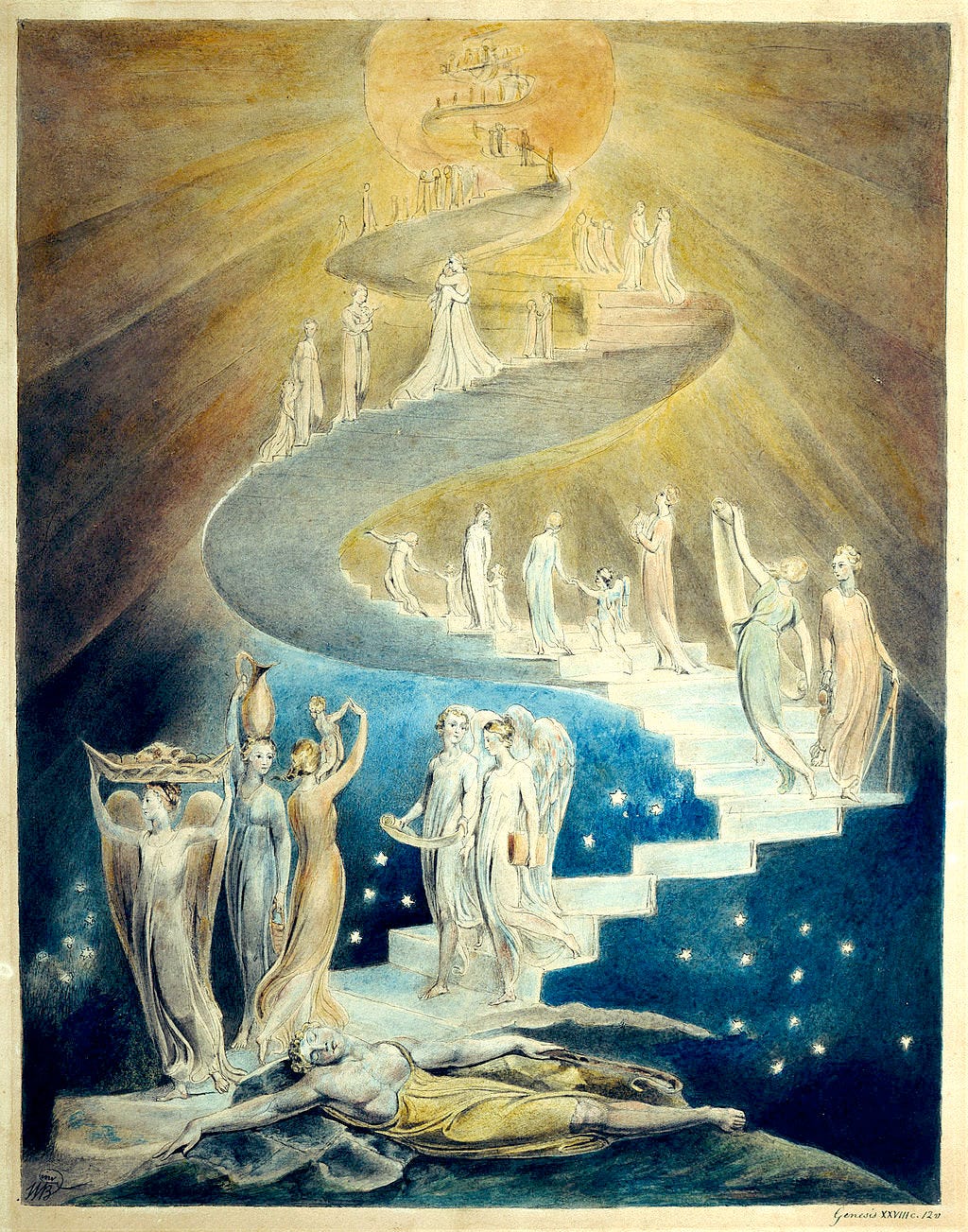
“Jacob’s Dream” by William Blake, via Wikimedia Commons
Entering Into God’s World
In this, the third instalment of my post: 7 Reasons Why you Should Read the Book of Revelation, I would like to offer some reflections on how John’s visions not only reveal a world but also create a world.
As one world falls apart and a new creation dawns, the Prophet of Patmos invites us to step into God’s world through the power of the Holy Spirit and to be transformed in the process, as he offers us a place to stand amid the shifting sands of post-modern thought.
The “Apocalypse of Jesus Christ” (Revelation 1:1) has been written not only to offer hope in the midst of crisis — as I indicated in my last newsletter — but to offer the audience an opportunity to view their everyday world from a new perspective—a heavenly, transcendent, God-centered perspective.
Banished to an island for his witness to the word of God (Rev. 1:9), and concerned for those to whom he addresses his work, John offers his audience a glimpse into heaven through the door that has been opened by the Holy Spirit (4:1).
Not unlike Jacob at Bethel, who sees a stairway extending upward to heaven (see Gen 28:11–16; John 1:51), John not only sees the visions he describes, but draws his readers with him into the heavenly world, beginning in chapter 4.
During a time of crisis it is given to an early Christian prophet to “draw back a veil” for his churches (hence the name Apocalypse, from the Greek apocalypsis, a “disclosure,” an “unveiling,” or “revelation”).
And as the curtain is lifted upon God’s world, not only is John permitted to see what he describes, but those to whom the book is addressed are invited to look over his shoulder through the open door and to share in these visions.
So it is that the faithful who listen to the reading aloud of the book (1:3)—“on the Lord’s day” (1:10)—stand with the prophet at the “threshold of a new world, [1] God’s world—where
God triumphs over evil through the death of Jesus and the suffering of his followers. [2]
John’s visions call us to rise above the sorrows, illusions, and confusion of this passing world, as they provide clarity and perspective concerning our place in it. Indeed, as the commentators observe, St. John offers us a viewpoint of this passing world “from the standpoint of heaven.” [3]
Our day-to-day world (whether ancient Rome or postmodern Toronto) looks very different when it is “opened to transcendence” and illumined by God’s glorious, radiant light. [4] As such, the book does not merely reflect the first-century world of its author, but, again, it also “creates a world.” [5]
“A Place to Stand in an Expanded Universe”
In the interplay of opposing symbols within the Book — images of heaven and earth, of the throne of God and the throne of Satan (Rev. 2:13), of spiritual warfare between angels and devils, of the smoke of Babylon and the sparkling luster of the New Jerusalem— the faithful are offered a deeper insight concerning this passing world and their place in it.
In the words of one scholar, John’s visions offer his audience “a place on which to stand” in “an expanded universe.” [6] So it is then, that the audience is urged to worship God, and God alone
To hold firm, to recognize the beast behind the beauty of Greco-Roman culture
and
to remain faithful witnesses. [7]
Throughout, John wants to bring us to the realization that the powers of the earthly empire have no claim to finality. The destiny of the world is in the hands of God and the Lamb, good will triumph, sin and evil will come to an end, and the old order will pass away as all things are made new in Christ.
Then as now, the faithful are invited to stand with the angels, to live the Gospel through the life of prayer, the sacraments, the love of neighbour, the poor and suffering, and to give bold, courageous witness to the values of the Gospel before an earthly empire that would build a world without God. In this way, the “seven churches” are invited to begin preparing — right now, without delay — to enter the New Jerusalem.
Joining the Angels in Praising God and the Lamb
We too are led to consider our own attitudes toward the political, economic, social, and technological forces that shape a globalized, post-modern, post-human, post-national, post-truth earthly empire, and to choose God in all circumstances.
And as we do, we need to learn to live in God’s world, not as a flight from reality but as a means of spiritual renewal. Above all, John calls us today to enter God’s world in the spirit of a hope–filled rehearsal, as we prepare for what awaits us beyond death’s door.
It is through the power of the Holy Spirit that the faithful are called to begin to see both the open heaven and the passing world around them through the eyes of God and the Lamb, as they witness prophetically to the “eternal Gospel” (Rev. 14:6) against the values of the worldly empire. And so, John encourages the faithful to begin to prepare for their own passage to the heavenly homeland through the purification of their spiritual vision. [8]
And when the beleaguered, persecuted churches on earth gather together in worship and join their voices to those of the angels who worship God unceasingly (Rev. 4:8), it becomes possible for them to experience even now the joy that will be ours in the New Jerusalem.
According to St. Andrew of Caesarea, the Apocalypse provides us with a powerful and coherent picture of
one Church of angels and human beings
united in their exalted praises of God and the Lamb. [9]
Let us pray, then, for the grace to prepare every single day to enter the New Jerusalem. For, ultimately, in the words of St. Bonaventure,
Into this heavenly Jerusalem no one enters unless it first descends into the heart by grace, as St. John beheld in the Apocalypse. [10]
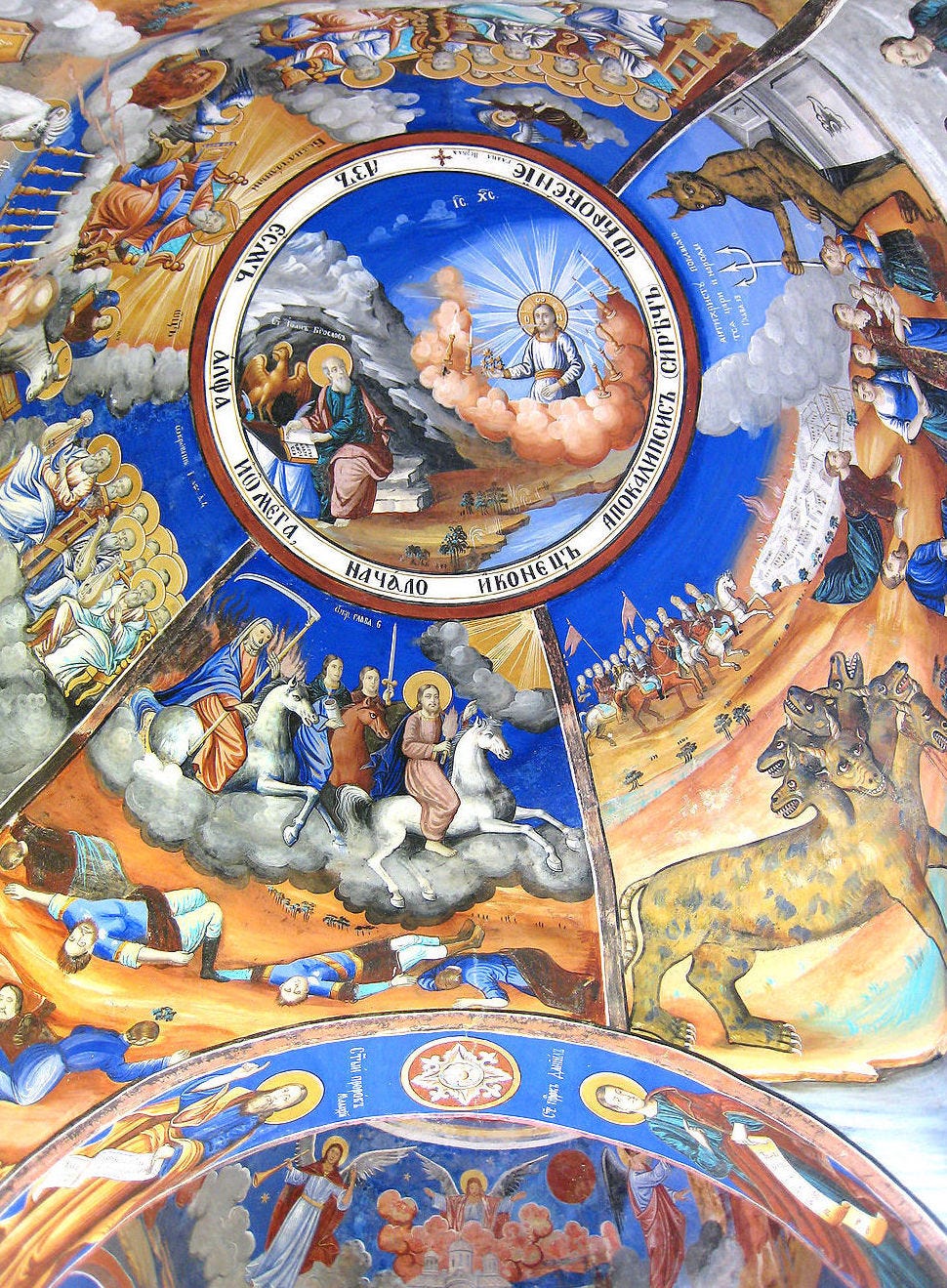
“Orthodox Apocalypse”, Edal Anton Lefterov, Public domain, via Wikimedia Commons
[1] See comments by R. L. Jeske, “Spirit and Community in the Johannine Apocalypse,” New Testament Studies 31 (1985), p. 458, and literature cited. Whether the early Christian Eucharist may have been intended as the original setting (or what scholars refer to as the “theatre of reception”) for the reading aloud of the book remains an intriguing possibility that is not without support among commentators. See, A.J.P. Garrow, Revelation, (New Testament Readings; London & New York: Routledge, 1997), p. 3–4.
[2] David L. Barr, “The Apocalypse of John as Oral Enactment,” Interpretation, 40 (1986), p. 256.
[3] See comments by David A. daSilva, Seeing Things John’s Way: The Rhetoric of the Book of Revelation, (Louisville, KY: Westminster John Knox Press, 2009), p. 93-95, and literature cited.
[4] Richard Bauckham, The Theology of the Book of Revelation, (Cambridge, UK: Cambridge University Press, 1993), p. 7-8.
[5] Leonard L. Thompson, The Book of Revelation: Apocalypse and Empire, (New York: Oxford University Press, 1990), p. 77.
[6] Ibid., p. 32.
[7] David L. Barr, Tales of the End: a Narrative Commentary on the Book of Revelation, (Santa Rosa, CA: Polebridge Press, 1998), p. 180.
[8] I am grateful to Professor Ugo Vanni for his insightful comments in this regard.
[9] Hermēneia eis tēn Apokalypsin, Patrologia Graeca, vol. 106, col. 610.
[10] See, The Journey of the Mind to God, trans., Philotheus Boehner, O.F.M., ed. Stephen F. Brown (Indianapolis: Hackett Publishing, 1993), p. 24.