
Brave Witness
Part 6 of the series "7 Reasons why you Should Read the Book of Revelation"

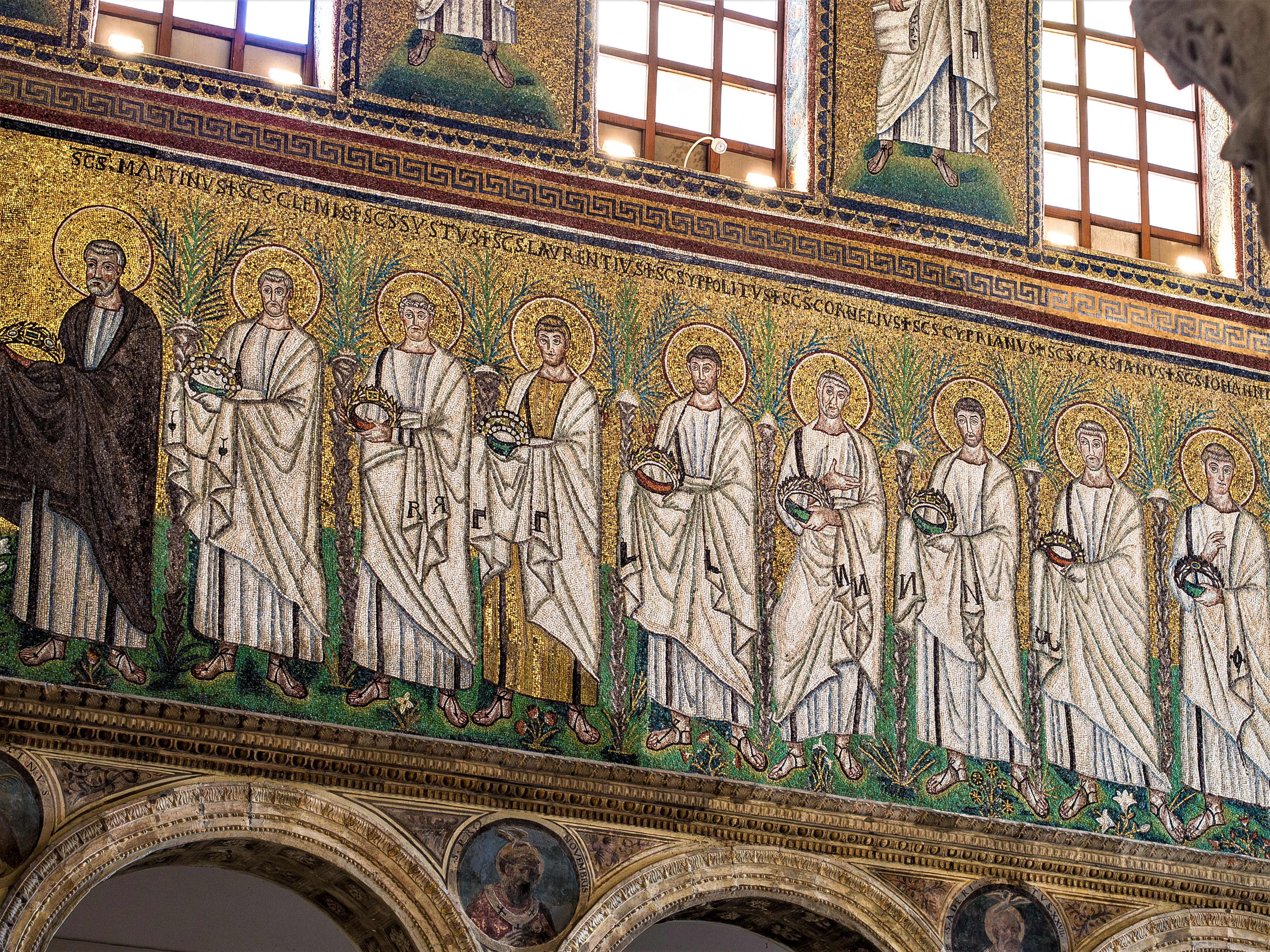
Ravenna Basilica of Sant’Apollinare Nuovo, Mosaic, by Ruge, Wikimedia Commons
Jesus Wants Brave Witness to the Gospel
In this, the 6th instalment of my series: 7 Reasons Why you Should Read the Book of Revelation, I examine the Book’s call to give brave public witness to the values of the Gospel.
It is in the so-called “letters section” (chapters 2-3), that the glorified Jesus Himself speaks directly to the churches of Asia Minor, calling them to live the life of faith without compromise.
Here, one scholar observes that:
John wants “conquerors.” He wants his hearers to “overcome” the challenges to faithful discipleship and the forces, social and spiritual, that conspire to defeat disciples in their contest to keep the commandments of God and to keep faith with Jesus. And for John, “overcoming” entails gaining critical distance from, and engaging in prophetic witness in the midst of the domination systems of Roman Asia Minor. [1]
Taken together, these messages issue a warning against compromising the faith for the sake of our own social standing, comfort and well-being in this present life (Rev. 3:14-22).
“Purchase from Me Gold Refined by Fire, that you may be Rich,” (Rev. 3:18)
As the glorified Jesus issues the call to brave, heroic witness to the values of the Kingdom of Heaven against the values of the earthly empire, it becomes clear that the situation reflected in this “letters section” is far from ideal. The churches of Asia Minor reflect a mixture of faithfulness and unfaithfulness, of ardour and lukewarm indifference, of bravery and cowardice, of grace and sinfulness.
The weeds and the wheat about which Jesus speaks in His parables (Matt. 13:24–30) grow together among the seven churches of Asia Minor. The angelic Jesus who addresses the congregations in the Spirit speaks to the churches in a decidedly forthright, unembellished, and unadorned way.
And while the voice of the risen and glorified Christ calls out clearly and consistently toward the path of conversion, the respective diagnoses, threats, and admonitions contained in these letters do not tell the whole story.
We also find a series of “promises to the victors,” in which Jesus guarantees rewards to a prophetic (22:7), priestly and royal people who remain faithful witnesses to the very end.
I will discuss these remarkable promises in further detail in the next post.
“The Glory that is to be Revealed in Us”
While addressed to the angel of each specific church and intended for the faithful of that community, these promises extend to all who would strive to become victors by giving brave witness to Christ (cf., 21:7; 1 Jn. 5:4–5).
Taken together, the letters serve to articulate a comprehensive vision of why it is that the churches should live their faith to the fullest, and why it is that they should have no fear of witnessing to the Gospel. Like St. Paul, John’s message serves to shift our focus from “the sufferings of the present time” to “the glory that is about to be revealed in us” (Rom. 8:18).
Our faith conveys an exalted vision of a humanity which is in the process of being made new, of being “angelified” in Christ, as John describes what the human person has been created for, and is called to become, through the life of grace (cf., Luke 20:36 and the term isangeloi, “like” or “equal to the angels”).
Jesus invites us to follow courageously the path leading along the narrow road (Mt 7:13–14) which is, in the words of St. Pope John Paul II
Situated between two lights: the anticipatory light of the Transfiguration and the definitive light of the Resurrection. [2]
At the same time, Jesus tells us to be prepared to suffer as He has suffered, for
No servant is greater than their master (Jn. 15:20).
John is saying, do not be afraid to be rejected, denied, or persecuted for the sake of the Gospel, for those who remain faithful witnesses to the end will come to share in Christ’s own glorious transformation.

The Transfiguration, by Peter Paul Rubens, via Wikimedia Commons with Moses and Elijah on either side of Christ on Mount Tabor
Beyond the imagery of the faithful reflected in the Johannine Jesus’ admonitions to Peter to — “feed my sheep” (Jn. 21:17)—and the transition from servants to friends signaled in John 15:15, is the Seer’s vision of a humanity that is glorified and transfigured in Christ (Rev. 2:28, “I will give you the morning star”).
Ultimately, the Apocalypse speaks to us of a humanity that is in the process of being “sealed with the glory of Christ’s own face,” as St. Ambrose observes. [Explanation of the Psalms,” Psalm 43, 89–90]
Jesus Calls the Faithful to Patient Endurance
While the promises to the victors are marvelous to contemplate, it is clear that they can only be won at a considerable cost.
Thus the angelic Jesus of the first three chapters of Revelation beckons the faithful to become a prophetic people, who “hear and keep” the book’s words of prophecy (1:3; 22:7), as they hold fast to the testimony of Jesus (19:10), and conquer the world through the mystery of Christ’s own suffering, death, and Resurrection.
When John first describes his own situation, he speaks of being “a brother and fellow participant” in “the tribulation and the kingdom and the patient endurance” (Rev. 1:9) that characterize Christian life in this world.
Certainly, the Book’s heightened sense of living in “the final hour” (1 Jn 2:18) has been a characteristic of the Christian experience of time since the Ascension.
Revelation’s symbolic universe portrays a world divided between those who strive to live according to the values of the Gospel, and those who refuse to dissociate themselves from taking part in the sinfulness that marks the earthly empire, (symbolized by the city of Babylon, cf., 18:2).
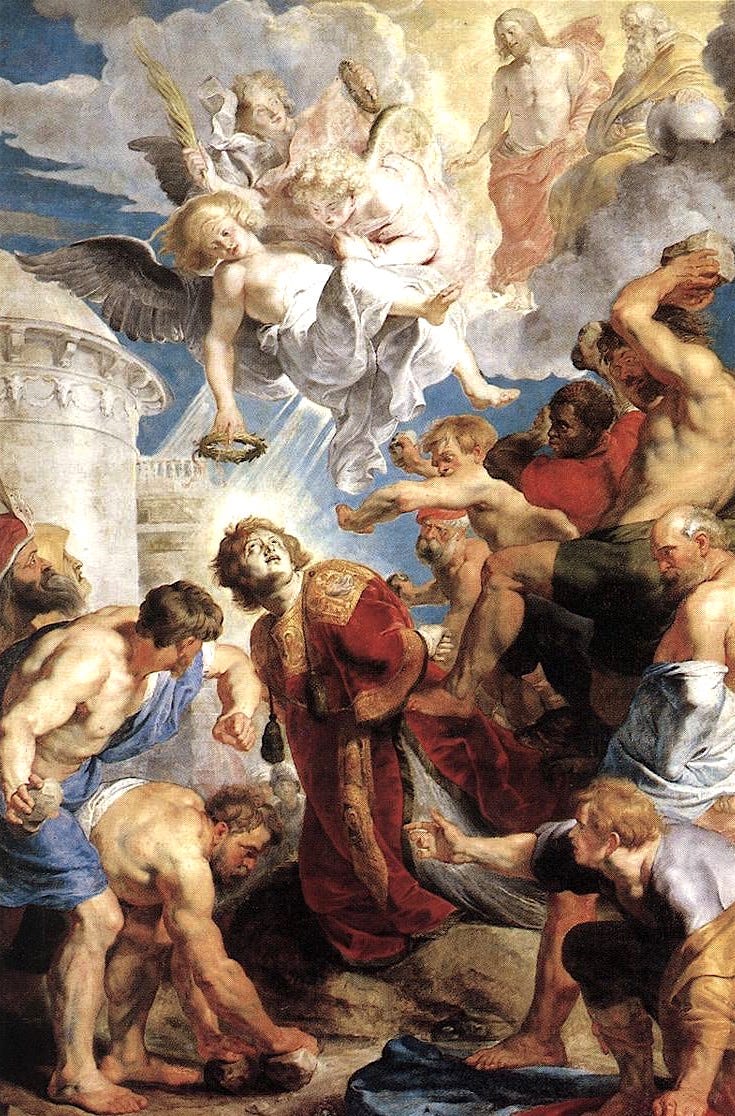
Peter Paul Rubens, “The Martyrdom of St. Stephen”, Wikimedia Commons
Living in Two Worlds at the Same Time
These visions invite the reader “to look behind the veil of ordinary experience . . . and see the true order of life” [3], as the fulfillment of God’s promise of salvation draws near. Those who adhere faithfully to the rule of God and Christ in this world, will always do so in the midst of danger and rejection. Along with Jesus and the prophet of Patmos, theirs is a suffering witness to the faith (2:9).
What the Apocalypse calls forth in the faithful is patient endurance. The Book of Revelation teaches that it is through faith and patient endurance alone, and never through the use of violence, that one achieves victory over this world. For the “victors” have conquered:
By the blood of the Lamb and by the word of their testimony (Rev. 12:11).
Throughout, the Book of Revelation speaks to its audience
In mystic fashion about the challenge and the comfort of living in two worlds at the same time . . . [4]
. . . one that is rapidly fading, and one which even now, is in the process of coming into being through the power of the Holy Spirit. In this way John challenges us to a renewed perception of the presence of God in creation and in our everyday lives. And so, we are led to ask:
Are we living in two worlds at the same time, or only in one?
Are we actively seeking God’s presence through prayer and the sacramental life of the Church?
Are we giving brave public witness to the values of the Kingdom?
Are we living the Gospel as signs of contradiction to the values of a postmodern society that has rejected God?
The Book of Revelation envisions that those who give a bold and courageous public witness to the values of the Gospel will come to acquire a share in Christ’s own divine glory—beginning even in the present life.
Those who have borne the marks of Jesus’ own suffering and rejection will also bear the marks of His glory.

“Two worlds collide”, photo by Christian Kortum, Denmark, via Flickr
Entering Bravely into the Spiritual Struggle
John’s is a very relevant message in our post-Christian, post-truth era, when the culture of death has given way to a dictatorship of relativism, that would exclude the Gospel from the public square. Ours is a time when there are some in the mainstream media who would “cancel” the Rosary, associating it with a form of violent right-wing extremism.
Read: The Transhuman: Reaching out Toward God and the Divine - Part 1
Once again, the Apocalypse calls forth in its audience an audacious prophetic witness that is both willing and able to confront and to confute the cultural, social, and political countercurrents that demand acquiescence, accommodation, and compromise.
So it is that St. John challenges his listeners to become
more marginalized, edgier disciples leading lives of costly testimony. [5]
Indeed, as philosopher Alasdair MacIntyre observes, in our new dark ages:
The barbarians are not waiting beyond the frontiers, they have already been governing us for quite some time. And it is our lack of consciousness of this that constitutes part of our predicament. We are not waiting for Godot, but for another - and doubtless very different St. Benedict. [6]
How best to chart a course through the dark forests of postmodernity toward a true renaissance in our time remains a topic for discussion and debate. The courageous witness of the Saints of the Church provide a great source of inspiration: St. Benedict, St. Patrick, St. Boniface, St. Catherine of Siena, St. Clare, St. Francis of Assisi and St. Gregory the Great - all have a great deal to teach us.
Recognizing the spiritual battle that is raging around us, St. Maximilian Kolbe’s approach to Marian consecration invites us to contemplate the “Woman Adorned with the Sun” (Rev. 12), and to look upon Mary the Mother of God as the model and “Star of the New Evangelization.”
Together with St. Michael the Archangel, it is the Woman Adorned with the Sun who challenges us to strive in every circumstance to overcome the powers of darkness by bringing forth the light, the love and the mercy of Her Son into our world through our courageous witness to the values of the “Eternal Gospel” (Rev 14:6), that it may shine brightly for all to see.
Our Lady Queen of Heaven pray for us!
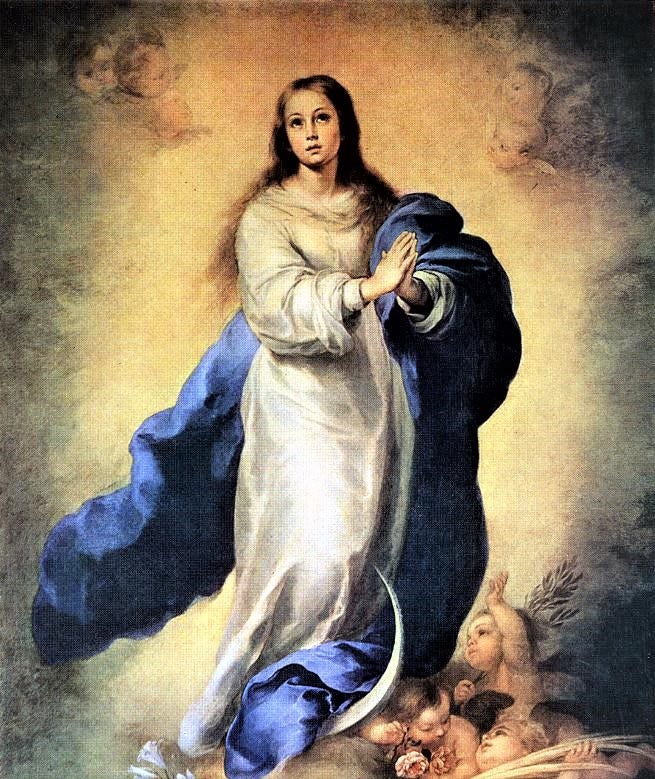
“Immaculate Conception”, Bartolome Esteban Perez Murillo, Wikimedia Commons
[1] David deSilva, Seeing Things God’s Way: the Rhetoric of the Book of Revelation, (Louisville, KY: Westminster John Knox Press, 2009), p. 70.
[2] St. John Paul II, Vita Consecrata, 25 March 1996, no. 40.
[3] See David L. Barr, “Doing Violence: Moral Issues in Reading John’s Apocalypse,” in Reading the Book of Revelation: A Resource For Students, Resources for Biblical Study 44 (Atlanta: Society of Biblical Literature, 2003), p. 106.
[4] Håkan Ulfgard, “Reading the Book of Revelation Today,” in Is The World Ending? Concilium 4, ed. Seán Freyne and Nicholas Lash (Maryknoll: Orbis Books, 1998), p. 38.
[5] Harry O. Maier, Apocalypse Recalled: The Book of Revelation After Christendom (Minneapolis: Augsburg Fortress Press, 2002), p. 29.
[6] Alasdair MacIntyre, After Virtue: A Study in Moral Theory, (Notre Dame, IN: University of Notre Dame Press, 2007), p. 219.